
$70.89
Stochastic Actor-Oriented Models for Longitudinal Networks—
$70.89
The Story
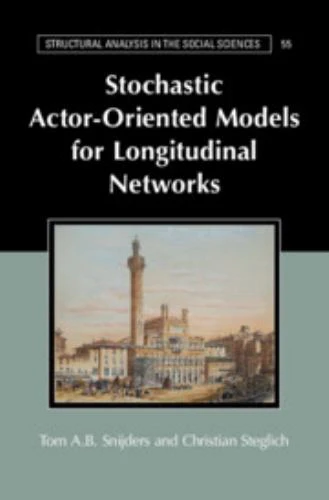
Interest in social networks – patterns of relations between social actors such as individuals, corporations, and countries – has grown in the last decade, and analysis of longitudinal network data has moved forward strongly. Social networks often change; understanding this process, where changes lead to other changes, requires tools that can uncover the rules driving these changes. In 'Stochastic Actor-Oriented Models for Longitudinal Networks,' Tom A. B. Snijders and Christian Steglich bring together the first comprehensive textbook on the Stochastic Actor-Oriented Model (SAOM), a leading method for analyzing dynamic network data. They present the diverse SAOM variants developed over the past three decades, covering the co-evolution of networks and actor attributes as well as the co-evolution of multiple one-mode and two-mode networks. Providing a foundation for applying the methods as well as advice for problems encountered in practice, this book offers a detailed guide into the best practices of modeling longitudinal network data.
Description
Interest in social networks – patterns of relations between social actors such as individuals, corporations, and countries – has grown in the last decade, and analysis of longitudinal network data has moved forward strongly. Social networks often change; understanding this process, where changes lead to other changes, requires tools that can uncover the rules driving these changes. In 'Stochastic Actor-Oriented Models for Longitudinal Networks,' Tom A. B. Snijders and Christian Steglich bring together the first comprehensive textbook on the Stochastic Actor-Oriented Model (SAOM), a leading method for analyzing dynamic network data. They present the diverse SAOM variants developed over the past three decades, covering the co-evolution of networks and actor attributes as well as the co-evolution of multiple one-mode and two-mode networks. Providing a foundation for applying the methods as well as advice for problems encountered in practice, this book offers a detailed guide into the best practices of modeling longitudinal network data.